

“Be better with money” is vague. Habits make it concrete—small actions you repeat until progress becomes automatic. Below are ten high-impact habits with quick-start steps, simple automations, and metrics so you can see results without guesswork.
General information only—not financial, legal, or tax advice. Everyone’s situation is different; adapt these ideas to your income, debts, and goals.
1) Pay Yourself First
What it is: Move money to savings/investing before spending it.
Do it now: Pick a percentage you can keep (even 1–5% to start). Create a separate high-yield savings for your emergency fund.
Make it automatic: Set a payday transfer (e.g., 1st & 15th). Increase by +1% every quarter.
Metric: Savings rate = (Total savings ÷ Net income). Aim to nudge it up each quarter.

2) Never Miss a Payment (Ever)
What it is: On-time payments protect your credit and cut fees.
Do it now: Turn on autopay for at least the statement minimum on every bill.
Make it automatic: Add calendar nudges 3 days before statement cut-offs to pay extra and keep balances lower when reported.
Metric: On-time payment rate = 100%. (Set alerts so “0 late fees” becomes a streak.)
3) Run a Simple Spend Plan You’ll Actually Follow
What it is: A budget that mirrors real life.
Do it now: Start with a light 50/30/20 template (Needs/Wants/Saving-Debt). If income varies, use a core bill floor (bare minimum) plus a flexible layer.
Make it automatic: Use account “buckets” or sub-accounts (Bills, Groceries, Fun, Goals).
Metric: Plan adherence ≥ 80% monthly (you hit the planned totals within a small band).
4) Prioritize Debt with One Clear Method
What it is: Pick Snowball (smallest balance first) or Avalanche (highest APR first) and commit.
Do it now: List debts (balance/APR/min). Choose a method and set a fixed extra (even $25/week).
Make it automatic: Schedule a mid-cycle extra payment to shrink reported balances.
Metric: Debt paydown rate (principal reduced per month). Celebrate each payoff.
5) Build a Real Emergency Fund
What it is: Cash buffer that prevents new debt.
Do it now: Start with $500–$1,000 mini-fund; then aim for 1–3 months of essential expenses (later 3–6).
Make it automatic: Payday transfers + any windfalls (refunds, bonuses) → % to the fund.
Metric: Months of expenses covered. Track it growing quarter by quarter.
6) Track Net Worth Monthly (Not Daily)
What it is: Assets minus liabilities—your big-picture score.
Do it now: Snapshot balances on the same date each month.
Make it automatic: A simple sheet that pulls current balances; calendar a 15-minute “close of month.”
Metric: 12-month trend direction (up is good). Ignore daily noise.
7) Capture Windfalls with a Rule
What it is: Pre-decide where irregular money goes.
Do it now: Choose a split (e.g., 50% debt/saving, 30% goals, 20% treat).
Make it automatic: When extra cash hits, trigger pre-set transfers that day.
Metric: % of windfalls allocated according to your rule (aim 100%).
8) Invest on Autopilot
What it is: Consistent contributions beat perfect timing.
Do it now: Enroll in your workplace plan or set a recurring transfer to a low-cost, diversified fund in a tax-advantaged account (where available).
Make it automatic: Payday contributions (e.g., 5–10% to start). Auto-increase annually.
Metric: Contribution rate and time in market (not market timing).
9) Plug the Leaks (Subscriptions & Bills)
What it is: Cancel, downgrade, negotiate.
Do it now: Export the last 90 days of transactions. Tag subscriptions and recurring bills.
Make it automatic: Quarterly subscription audit; set reminders to renegotiate internet, phone, insurance.
Metric: Annualized savings found and kept (track what stays canceled 90+ days).
10) Protect Your Money (Insurance & Security)
What it is: One bad event shouldn’t wreck your plan.
Do it now: Review health/auto/renters/home coverage, beneficiaries, and deductibles. Turn on 2FA for banking; use a password manager.
Make it automatic: Annual policy review; card-transaction alerts; consider credit monitoring/freeze if at risk.
Metric: Coverage gaps closed; incidents caught via alerts.
Your 30/60/90-Day Habit Build
Days 1–30 (Foundation)
Turn on autopay + payday transfers (Habits 1 & 2).
Map your spend and set buckets (Habit 3).
List debts, pick method, schedule extra payment (Habit 4).
Start mini-emergency fund (Habit 5).
Do a 90-day subscription audit (Habit 9).
Days 31–60 (Momentum)
Auto-enroll or increase contributions by +1–2% (Habit 8).
Establish your windfall rule (Habit 7).
First monthly net-worth snapshot (Habit 6).
Insurance/security check (Habit 10).
Days 61–90 (Refine & Lock-In)
Review results; re-allocate buckets by ±5%.
If debt progress stalls, increase extra payment or switch Snowball ↔ Avalanche.
Schedule quarterly reviews for subscriptions, insurance, and savings rate bumps.
Common Pitfalls (and Fixes)
Too many goals at once. Fix: Prioritize 1–2 for 90 days; park the rest.
Budget whiplash after one bad week. Fix: Course-correct at the next purchase, not next month.
Using savings as a checking overflow. Fix: Keep savings at a different bank; move only on schedule.
Chasing investment fads. Fix: Automate contributions; avoid timing bets.
Subscription relapse. Fix: Delete stored cards in app stores; set an approval step.
Frequently Asked Questions
How big should my first emergency fund be?
Practicing financial wellness habits can lead to a multitude of benefits that enhance your overall quality of life. These habits help in creating a sense of security and stability, which reduces stress related to financial uncertainty. By improving your financial literacy through informed budgeting and saving practices, you can make better financial decisions that set the groundwork for long-term savings and investment growth. Additionally, financial wellness promotes a healthy relationship with money and encourages proactive planning for future goals, such as retirement, education, and major purchases.
How can I start incorporating these financial habits into my daily routine?
Incorporating financial wellness habits into your daily routine can start with small, manageable changes. Begin by tracking your expenses to gain insight into your spending patterns and identifying areas for improvement. Setting specific, achievable financial goals can motivate you to stick to your budget and savings plan. Utilize tools like budgeting apps or spreadsheets to monitor your progress regularly. Moreover, dedicating time each week to review your financial situation will help reinforce these habits, ensuring they become a natural part of your lifestyle over time.
Are these financial wellness habits suitable for everyone, regardless of income level?
Yes, the financial wellness habits outlined are designed to be adaptable for individuals at all income levels. Whether you are a student, a professional, or an individual on a fixed income, these habits can be tailored to fit your unique financial situation. The underlying principles of budgeting, saving, and investing are fundamental to financial health and can help anyone gain control over their finances. It’s important to assess your own circumstances and modify the habits to align with your income, expenses, and financial aspirations.
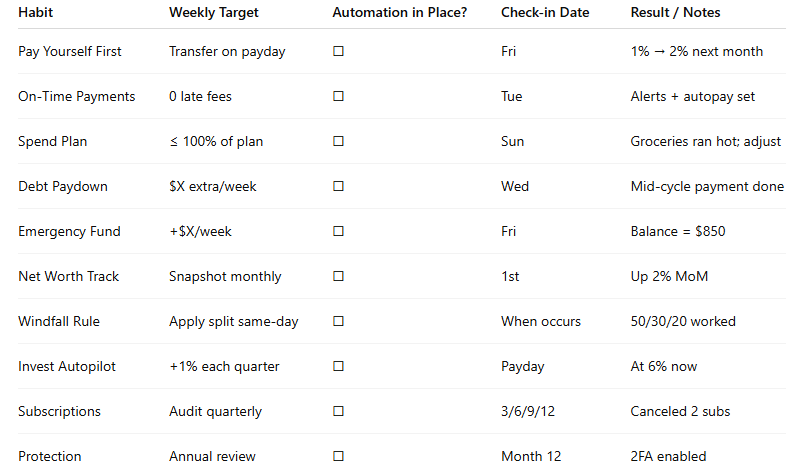
Habit Scorecard (Copy & Use)






Comments are closed.